In cheese manufacturing, salt addition is an important aspect of the production process and serves several functions. Salt modulates rind formation for brine-salted cheeses, inhibition of growth of microorganisms, ripening, texture, water binding, aroma and taste. Additionally, it is an important contributing factor for food safety and suppression of spoilage bacteria or variety specific undesired bacteria in cheese.
Salt is an important tool for the cheesemaker to influence the ripening process towards the desired variety and quality. Therefore, different cheese varieties require different salt contents, from 0.4% for Swiss cheese up to 4% or even 5% for blue cheeses. Salt serves as a flavour enhancer and influences aroma and trigeminal sensations.
Low-salt cheeses are bland and prone to flavour defects, such as bitterness or off-flavours. Moreover, in fat-reduced cheeses, salt influences aroma release. By modulating the growth of desired and undesired microorganisms and enzymes, salt influences the development of cheese flavour.
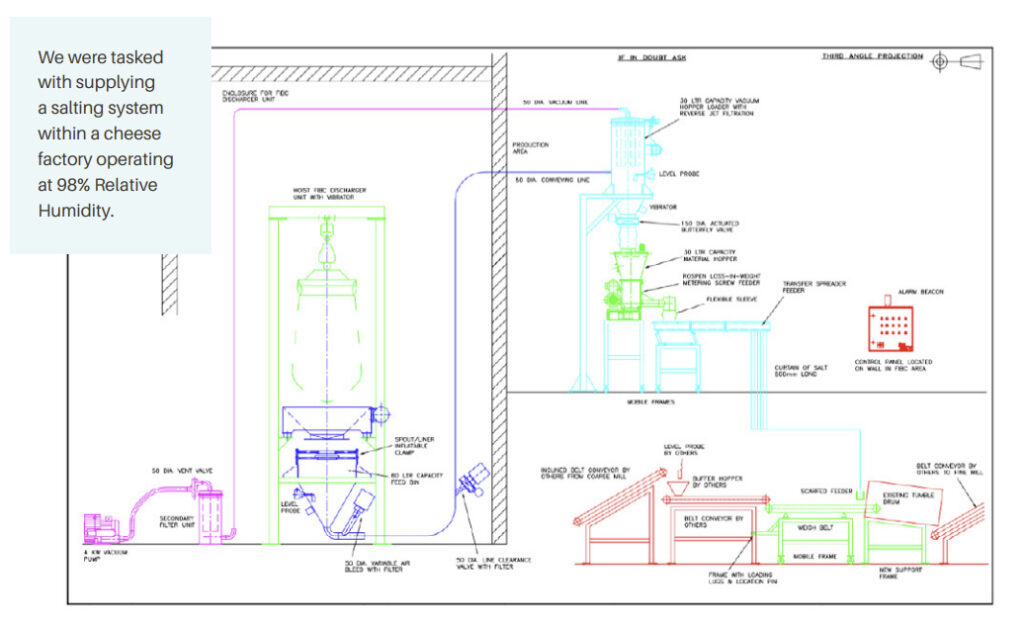
We were tasked with supplying a salting system within a cheese factory operating at 98% Relative Humidity.

The machine runs faultlessly at over 60 pots per minute (140 gram target) at less than 2% giveaway with a weighing resolution < 0.5g. With a small footprint, the machine is suitable for factories with low headroom. Additionally, the machine can be configured for a variety of bulk food products and custom-designed to handle different pot or tray dimensions.
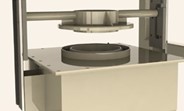
Salt arrived in 1,000kg FIBC’s and was stored in an environmentally cooled and dry area, approximately 50 meters away from the point of use. Rospen supplied a hoist loaded FIBC station which incorporated a vibrating bag support dish to aid the flow of material out of the FIBC. We contained the material using our pneumatically operated outlet spout clamp with inflatable clamping seal, allowing the spout to be sealed prior to opening and providing a dust tight connection.
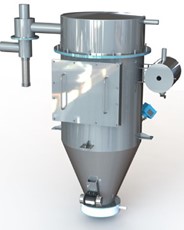
Rospen’s highly customisable lean-phase vacuum-conveying system transports salt to a receiving hopper above the salt dosing point. Notably, all product contact parts used in the entire system were manufactured from grade ‘316’ Stainless Steel. We achieved product discharge from the receiving hopper via the hopper cone-mounted vibrator and pneumatically operated butterfly valve. Due to the enclosed design of the transfer system, salt arrived in the hopper in a free-flowing state. We paid special attention to the reverse jet filter, compressed air and the filter media for breathing on the feeder to ensure no moisture entered either the vacuum transfer line or feeder. Any moisture ingress would impact operability.
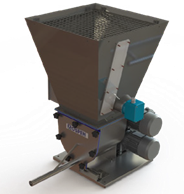
We controlled the salt flow rate using a Rospen loss-in-weight feeder at a salt addition rate specified at 20 to 72 kg/hr. Our standard design feeder enabled removal of the front plate using hand knobs. Front plate removal was protected by a magnetic safety switch. The standard weigh platform consists of a robust, twin angle frame containing three cantilever type load cells which are summated to automatically compensate for any off-center loading which may occur during hopper filling and emptying. Load cells benefit from an automatic self-centralizing mechanism which eradicates inaccuracies due to temperature change and unequal loading.
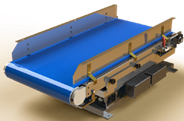
Curd is delivered to a Rospen weigh belt prior to discharge into a tumble drum. The correct amount of salt is ratioed via the Rospen loss-in-weight feeder into the throat of the tumble drum ensuring a homogeneous coating of salt on the curd. The addition of a “scarf” vibratory tray feeder was air purged, ensuring a steady “curtain” of salt.
Our engineers are masters in their field. Rospen engineers are degree-qualified and equipped with comprehensive knowledge and experience to provide custom solutions to unique client challenges.
Rospen systems are designed to perform with precision accuracy under all operating conditions.
Our systems are built to ensure long term reliability, maximum up-time and lowest on-going operational costs.
No matter the application, from pharmaceutical or food to quarry use, our machines are designed with easy strip-down features for hygienic cleaning.
Design ingenuity enables quick and easy access for maintenance and low downtime.
Standard design features ensure complete flexibility within existing manufacturing.
Unit 7, Waterside Business Park
Haslingden
Rossendale
BB4 5EN
Telephone: +44 (0)161 304 5700
Email: [email protected]
One of our requirements of ISO9001 is to measure and review customer satisfaction. Please assist us by completing this short questionnaire.
Privacy Policy | Registration Number: 03728537 (England)